
Exploring covert operations, fractured identities, and the stories governments bury
An internal dispatch for thriller writers
CLASSIFICATION: Restricted
DISTRIBUTION: Cleared storytellers, narrative architects, and those willing to look beneath the surface
SUBJECT: Constructing espionage fiction with archival weight and psychological precision
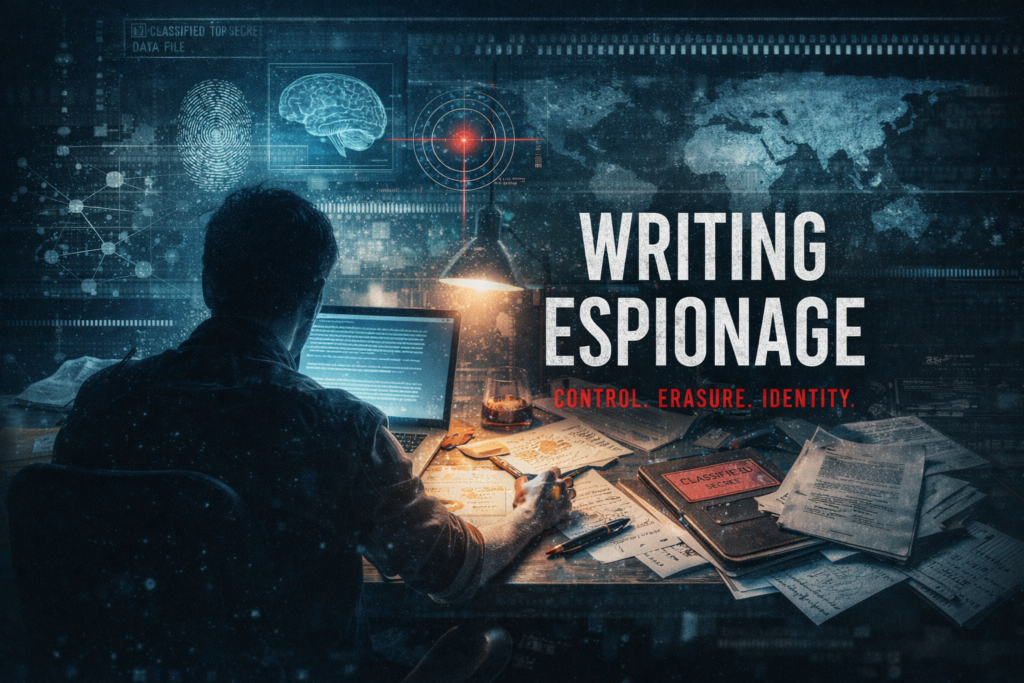 I. OPENING STATEMENT
Most espionage fiction fails for one reason:
It tries to be exciting before it tries to be believable.
Real intelligence work is not loud. It is not fast. It is not cinematic in the way most people expect.
It is documented, buried, redacted, and denied.
If you want to write espionage that feels real—stories that linger instead of entertain—you must approach the genre like an archivist, not a screenwriter.
This is The Black File mindset.
II. THE ILLUSION OF THE OFFICIAL RECORD
Governments do not tell stories.
They store versions of events.
Every report, every transcript, every “official” narrative is filtered through layers of:
- Political necessity
- Operational protection
- Strategic deception
Study real-world intelligence archives like the Central Intelligence Agency’s Reading Room:
https://www.cia.gov/readingroom/
Or the Federal Bureau of Investigation’s counterintelligence cases:
https://www.fbi.gov/investigate/counterintelligence
You’ll notice something immediately:
The truth is never presented cleanly.
It’s fragmented. Incomplete. Sometimes intentionally misleading.
That’s your blueprint as a writer.
III. FRACTURED IDENTITIES: THE CORE OF THE BLACK FILE
Espionage fiction is not about secrets.
It’s about what secrets do to people.
Writers like John le Carré understood this better than anyone. In The Spy Who Came in from the Cold, identity is not stable—it is assigned, stripped, and weaponized.
Similarly, Mick Herron’s Slow Horses shows what happens after failure—when agents become liabilities rather than assets.
And in Olen Steinhauer’s The Tourist, identity becomes operational currency—something traded, compromised, and expendable.
Key principle:
A spy is not a person with secrets.
A spy is a person reduced to secrets.
IV. COVERT OPERATIONS AS SYSTEMS, NOT SCENES
Writers often treat covert operations as isolated events.
That’s a mistake.
Operations are systems—long-running, multi-layered, and often invisible to the people inside them.
Study real cases through historians like Ben Macintyre:
- The Spy and the Traitor
- Agent Zigzag
Publisher links:
https://www.penguinrandomhouse.com/books/533041/the-spy-and-the-traitor-by-ben-macintyre/
https://www.penguinrandomhouse.com/books/289995/agent-zigzag-by-ben-macintyre/
What you’ll find:
- Operations unfold over years, not hours
- Success depends on restraint, not aggression
- Failure is often bureaucratic, not dramatic
Application for writers:
- Build the system first
- Then place your character inside it
- Then let the system break them
V. THE DOCUMENTARY TONE: WRITING LIKE A REDACTED TRUTH
To achieve the Black File tone, your prose must feel:
- Clinical
- Observational
- Detached—until it isn’t
Think less “action sequence,” more debrief report.
Watch how this tone is executed in adaptations like:
- Tinker Tailor Soldier Spy — https://www.imdb.com/title/tt1340800/
- Slow Horses — https://tv.apple.com/us/show/slow-horses/umc.cmc.2szz3fdt71tl1ulnbp8utgq5o
Notice:
- Dialogue is sparse
- Emotion is implied, not declared
- Information is withheld deliberately
Technique: Redaction Writing
Write scenes as if parts are missing:
- Omit key details initially
- Reveal them later in contradiction
- Allow the reader to assemble truth from fragments
VI. THE COST OF BURIED STORIES
Every black file contains two narratives:
- What happened
- What was recorded
Your story lives in the gap between them.
This is where psychological tension thrives:
- Agents who don’t know their full mission
- Handlers who lie by omission
- Programs that outlive their purpose
This is also where your work—especially something like Ghost Asset—finds its weight.
Because the most terrifying realization in espionage fiction is not:
“I’m being hunted.”
It’s:
“I was built for this.”
VII. FIELD DIRECTIVES FOR THRILLER WRITERS
1. Treat Information as Currency
Every detail has value. Spend it carefully.
2. Build Institutional Antagonists
The enemy is rarely a person. It’s a protocol, a directive, a system.
3. Use Time as Pressure
Not countdowns—delays. Waiting is more dangerous than action.
4. Let Identity Erode Gradually
Don’t shatter it. Wear it down.
5. Write for Aftermath, Not Impact
The explosion is irrelevant. The report afterward is where the story lives.
VIII. ADDITIONAL RESOURCES FOR OPERATIVES (WRITERS)
Craft & Community
- International Thriller Writers — https://thrillerwriters.org/
- Writer’s Digest (Thriller Writing) — https://www.writersdigest.com/tag/thriller
- MasterClass: Writing Thrillers (James Patterson) — https://www.masterclass.com/classes/james-patterson-teaches-writing
IX. CLOSING ENTRY
The Black File is not about what is known.
It is about what is hidden well enough to be forgotten.
As a writer, your job is not to invent spectacle.
Your job is to reconstruct the fragments.
To expose the seams.
To suggest that somewhere—beneath the official version—there is a truth no one was meant to read.
And then to ask the only question that matters:
Who benefits from it staying buried?
Bluesky Discussion
View on BlueskyNo replies yet. Be the first to comment on Bluesky!