Writers Beware ⚠️📚
Writing may be a solitary craft, but publishing puts you in a very public marketplace. And wherever there’s a marketplace, there are always a few wolves wandering around pretending to be helpful guides.
If you spend enough time in the writing world—especially in indie publishing circles—you’ll notice something quickly: writers are constantly targeted by scams.
Emails.
Direct messages.
Social media comments.
“Publishing opportunities.”
“Marketing services.”
Most of them sound exciting at first glance. That’s exactly how they’re designed.
So let’s talk about a few of the biggest traps writers should watch for.
The Vanity Press Trap
One of the oldest scams in the publishing world is the vanity press.
These companies will approach authors claiming they want to publish your book. They’ll flatter your writing, praise your “potential,” and promise to help launch your career.
Then the catch appears.
They ask you to pay thousands of dollars to publish your book.
Let’s be clear about something important:
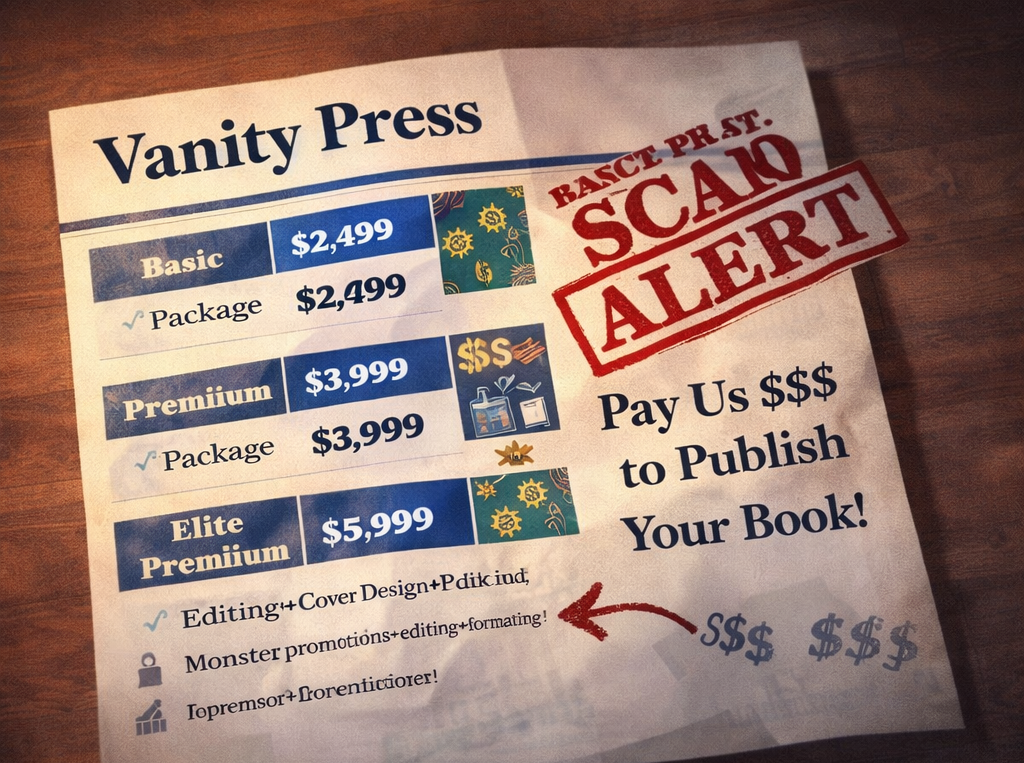 Real publishers pay authors. Authors do not pay publishers.
A legitimate publisher invests in your work because they believe they can sell it. If the money is flowing from you to them, that’s not traditional publishing—it’s a business model built on authors instead of readers.
Now, there are legitimate services in the self-publishing world—editing, cover design, formatting—but those are professional services, not “pay us to publish you” deals disguised as opportunity.
If someone claims they’re a publisher but requires you to pay upfront just to get your book released, step back and do some serious research.
 The Social Media “Promoter”
Another common scam happens right out in the open on social media.
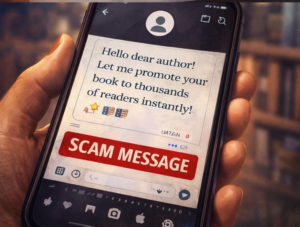
You post about your book and suddenly someone comments:
“Hello dear author! I can promote your book to thousands of readers!”
Or they slide into your DMs promising massive exposure for a small fee.
Here’s the uncomfortable truth: most of these accounts don’t have the audience they claim to have. Many are bots or marketing farms recycling the same message to thousands of writers every day.
You might pay for promotion and receive nothing more than a few automated posts sent to accounts that aren’t even real readers.
Real marketing takes real work—building relationships with readers, newsletters, communities, and platforms over time.
If someone promises instant bestseller status for $50 on Instagram… that’s not marketing.
That’s a digital carnival game.
A Real Example From This Week
Let me give you a real-world example of how this plays out.
Just a few days ago, someone on Instagram messaged me almost immediately after I posted about one of my books. They were very eager to “promote my book to their followers.”
Now, I’ve been around long enough to smell a scam coming down the road, but I decided to play along for a minute.
Within moments, they sent me a price list. Their packages ranged from $25 to $150 to promote my book across their social media channels to all of their followers.
Honestly, the prices were affordable enough that some new writers might jump at it without thinking twice.
So I did something interesting.
I told them I was interested—but I wanted to move the conversation to email and formalize the agreement with a contract.
I asked them to provide some basic information about the promotion they were offering.
Here’s what I asked for:
• A detailed description of the services included in the promotion package (number of posts, platforms used, graphics, videos, captions, scheduling, etc.).
• The social media platforms where my book would be promoted (Facebook, Instagram, TikTok, X, etc.).
• The number of promotional posts that would be made and the length of the campaign.
• Information about the target audience and how the promotion would reach readers in my genre.
• Whether the promotion included paid advertising and how those ads would be targeted.
• The follower counts and engagement rates for the social media accounts promoting the book.
• Examples or links to previous book promotion campaigns they had run.
• Whether graphics, videos, or promotional images would be created for the campaign.
• Whether I would have the opportunity to review what was being shared before it went live.
And then…
Crickets.
No response.
No email.
No contract.
Nothing.
What’s even more interesting is that I’ve had three nearly identical conversations this week with different accounts sending the same messages.
When someone is clearly copying and pasting the exact same pitch to dozens—or hundreds—of authors, that’s your cue.
Run. Don’t walk. And definitely don’t send them a dime.
Writers Protecting Writers
The best defense we have as authors is community.
Talk to other writers.
Ask questions.
Share warnings when something feels suspicious.
The indie writing world survives because authors help each other navigate the maze of publishing. Every time someone calls out a scam, it protects the next writer who might otherwise fall into the trap.
The road to publishing is already hard enough.
Writers should be fighting blank pages and deadlines—not scammers.
Bluesky Discussion
View on BlueskyNo replies yet. Be the first to comment on Bluesky!